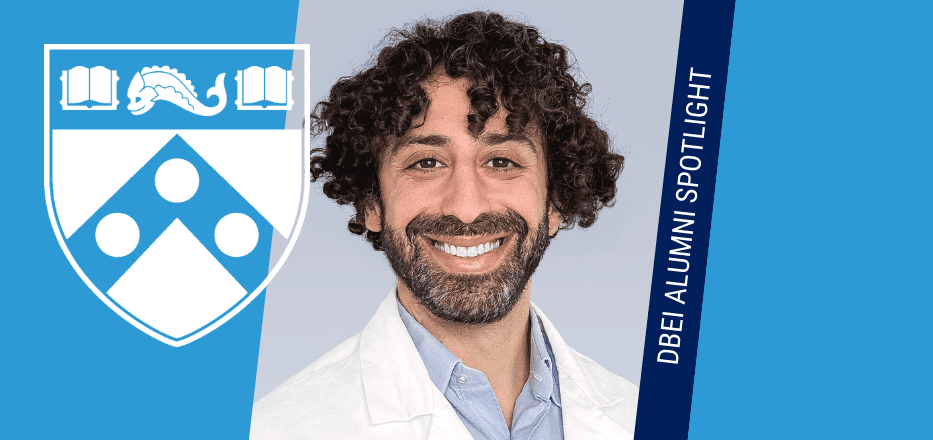
Graduate Program: MSCE (Clinical Epidemiology), Center for Clinical Epidemiology and Biostatistics (2018)
Current Title: Associate Professor of Clinical Medicine, Perelman School of Medicine
Location: Philadelphia, Pennsylvania
Cameron Baston, MD, MSCE, is a 2018 graduate of the MSCE program, administered by the Center for Clinical Epidemiology and Biostatistics (CCEB) at the University of Pennsylvania. Before entering the MSCE program, Dr. Baston earned a BS in Mechanical Engineering from the Massachusetts Institute of Technology in 2004, followed by an MD in Medicine from Jefferson Medical College in 2011. As an MSCE student, he was co-advised by Scott D. Halpern, MD, PhD, M.Bioethics, a faculty member in the Leonard Davis Institute of Health Economics and Director for the Palliative and Advanced Illness Research (PAIR) Center at the University School of Medicine.
Today, Dr. Baston is an Associate Professor of Clinical Medicine at the Perelman School of Medicine.
We reached out to Dr. Baston to learn more about his current work and to invite him to reflect on his time as an MSCE student in the Center for Clinical Epidemiology and Biostatistics (CCEB) at Penn.
What is a typical day like in your current role as Director of Medical Affairs Biostatistics?
I feel fortunate to have something of a portfolio career. About half my time is spent in direct clinical care of critically ill patients in the intensive care unit. During that time I’m often applying the lessons from my MSCE to interpretation of available literature for clinical decision making and instruction of physicians in training. I also serve on the editorial board of several medical journals where I review submissions and help with strategic decisions for the journal. Some of my time is spent in a formal education role, with a focus on point-of-care ultrasound, both studying the application and skill acquisition and in direct instruction of the skill set. Another role is through my work in medical device innovation at Penn Health Tech, where as the Faculty Associate Director I design and implement a fellowship for clinician innovators and serve in an advisory role for multiple internal and external medical device groups. This work draws in my skill in study design and interpretation in new and varying ways.
What do you value most about your current role?
The variety and challenge! I also love that each of my jobs within my role carries a clear narrative of benefiting patient care or patient outcomes.
Why did you choose the MSCE program?
The skillset of the Penn MSCE seemed to provide broadly applicable utility for any of the multiple domains I planned for my career. This included evidence interpretation for my clinical practice, experimental design for my research, cost-effectiveness analysis, and connection to a network of content experts and mentors that I continue to utilize.
What was the most meaningful part of your experience in the program?
The opportunity to focus entirely on skill development, with the protection provided by a T32 NIH grant, meant that I was able to go deeper into statistics, epidemiology, and evidence interpretation than ever before. In the modern era, where skepticism of medical evidence has become a cultural phenomenon, the ability to distill and differentiate the results of studies for patients, families, and friends has been incredibly valuable.
What faculty member, mentor, or course was most influential for you and why?
My direct thesis advisors, Drs. Norma Coe, Scott Halpern, and Michael Harhay were incredible in the value and guidance they could deliver in incredibly efficient moments. The course in medical literature interpretation, led by Dr. Kit Delgado, also stands out as something I refer to on a regular basis.
What advice would you offer a current or aspiring student?
To keep it philly-centric, trust the process. I was incredibly impressed by how well the program progressed from survey level exposure to more specific courses that targeted my thesis development.
What is on the horizon for you in terms of your career goals or research path?
I’ve recently been promoted to Associate Professor, so I’m working on defining how to raise each of my areas of passion to the next level while developing mentees into their own roles.